

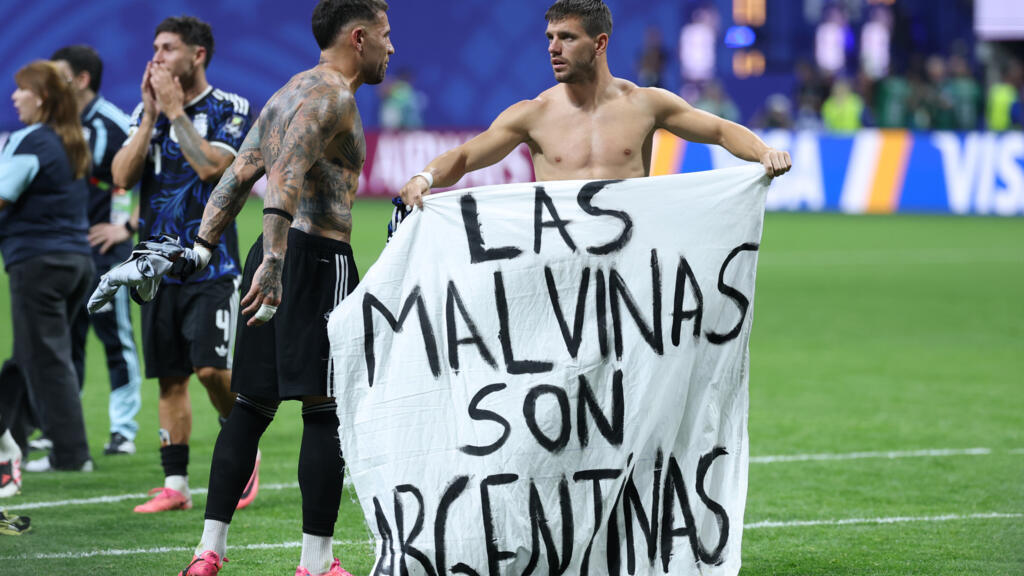
The British government has called on FIFA to investigate Argentina’s national team after several players celebrated their World Cup semifinal victory over England with a banner asserting Argentina’s sovereignty over the disputed Falkland Islands.
The controversy erupted after Argentina’s 2-1 win over England in Wednesday’s semifinal in Atlanta, where players posed with a banner handed to them by fans that read, “Las Malvinas son Argentinas” (“The Malvinas are Argentine”). Argentina refers to the Falkland Islands as Islas Malvinas.
U.K. Business Secretary Peter Kyle described the display as “entirely inappropriate” and urged world football’s governing body to launch a formal investigation. “I hope FIFA will do a proper inquiry,” Kyle told Times Radio, arguing that political issues should remain separate from football. Prime Minister Keir Starmer’s office backed the call for an investigation on Thursday.
The World Cup might not be ours, but the Falkland Islands definitely are,” a spokesperson for Starmer said. “Self-determination rests with the islanders and our commitment to the Falklands will never waver.” The spokesperson confirmed that the prime minister supported calls for FIFA to investigate the incident. Liberal Democrat leader Ed Davey also condemned the players’ actions, saying those involved “must be barred” from Sunday’s World Cup final.
The Falkland Islands, a British Overseas Territory located about 480 kilometres off Argentina’s coast, have been the subject of a long-running sovereignty dispute between London and Buenos Aires. Argentina claims the islands, while Britain maintains sovereignty, citing the islanders’ right to self-determination.
The dispute led to the 1982 Falklands War after Argentina’s military dictatorship invaded the islands. The 10-week conflict ended in a British victory and claimed the lives of 649 Argentine troops, 255 British service personnel and three islanders. Ahead of Wednesday’s semifinal, Argentina’s Vice-President Victoria Villarruel described the British as “invaders,” reflecting the political backdrop surrounding the match.
FIFA’s disciplinary code prohibits political messaging at stadiums, including “message[s] that [are] not appropriate for a sports event” and displays of “a political, ideological, religious or offensive nature.” Under the regulations, sanctions can include fines ranging from $5,000 to $20,000. Among the Argentina players photographed with the banner were Manchester United defender Lisandro Martínez, Liverpool midfielder Alexis Mac Allister and Tottenham Hotspur defender Cristian Romero.
Martínez defended the team’s actions after the match. “We couldn’t let the Argentine people down,” said Martínez, who has played in England with Manchester United for the past four years. Midfielder Leandro Paredes also addressed the banner, saying: “Sadly, it is a sad part of our history, for everyone involved in that chapter of, I repeat, our history. And it hurts. We knew we were playing for them, too.”
Kyle praised England’s players for their conduct, saying their behaviour showed “the perfect contrast” to that of the Argentine team. Speaking to the BBC, he added: “Politics needs to be separate from football. In fact, the World Cup has one of its central tenets that politics is separate from football. That is now a matter for FIFA.”
FIFA had not commented publicly on the incident as of Thursday, July 16. The governing body has previously sanctioned political displays at international tournaments. In 2014, Argentina’s football federation was fined 30,000 Swiss francs after players displayed the same “Las Malvinas son Argentinas” slogan before the World Cup in Brazil.
FIFA also banned South Korea’s Park Jong-woo for two World Cup qualifying matches after he displayed a banner reading “Dokdo is our territory” following the men’s football bronze medal match at the 2012 London Olympics, ruling that such conduct “cannot be tolerated.”
At the 2022 World Cup in Qatar, FIFA fined the Serbian Football Association 20,000 Swiss francs after a political banner depicting Kosovo as part of Serbia was displayed in the team’s dressing room before a match against Brazil.
The latest controversy comes ahead of Sunday’s World Cup final between Argentina and Spain in East Rutherford, New Jersey, where FIFA President Gianni Infantino is expected to attend alongside U.S. President Donald Trump and Argentine President Javier Milei.

