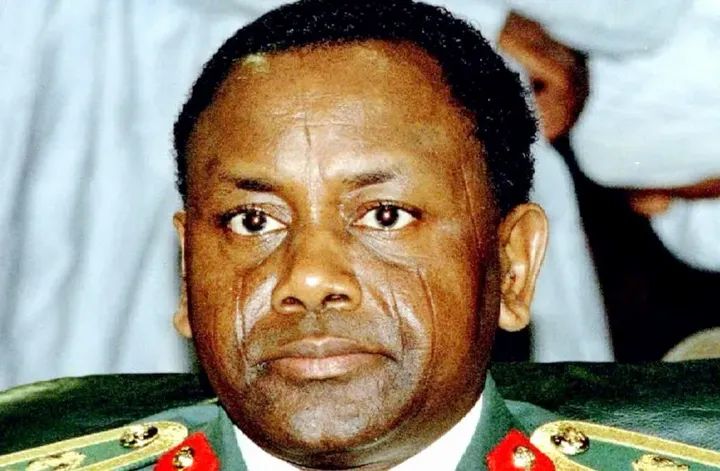
The lady who was with former military Head of State, Gen. Sani Abacha, when he suddenly passed on, said she didn’t k!ll him, claiming that he d!ed on top of her during intercourse.
A retired security operative, Dennis Amachree, said the lady, an Igbo pharmacist, made the confession when he interrogated her over Abacha’s mysterious d3ath, the Nation reported
Amachree, who gave his own version of Abacha’s last moments, clarified that the former military ruler passed on around 4.05 am on June 8, 1998, at the Aso Villa, Abuja, in the presence of the lady during an intimate affair.
Abacha was Nigeria’s military ruler between November 1993 and July 1998 when he suddenly d!ed at 54.
Given the manner of his d3ath, there were speculations about what k!lled him and the circumstances of his d3ath.
“The lady pharmacist’s account, on whom Abacha apparently had a coitus-induced cardiac arrest, remains the true position, and puts an end to the conspiracy theories and half-truths that have gone viral,” he stressed.
Amachree, who was the Assistant Director of Operations and Intelligence at the Lagos State SSS Command, at the time of Abacha’s d3ath, emphasised that “any other narrative is an act of deceit and a disservice to our countrymen and women.”
He made the revelation in his 348-paged book, just released, titled: ‘DSS @40: My journey behind the shield.
The retired Assistant Director of Department of State Services (DSS) said after witnessing Abacha’s d3ath, the lady-pharmacist immediately joined the next flight to Lagos.
My team located and brought her to my office. I interrogated her myself. The first thing she said to me was : ‘I did not kill him, he d!ed on top of me.’ After her detailed account, I called the Director in Abuja, and she was immediately flown back,” he said.
Abacha died barely a month before the d3ath of Chief Moshood Abiola, winner of the historic June 12, 1993 presidential election, on July 7, 1998, who was in Abacha’s custody.
Following the protest and furore that followed Military President Gen. Ibrahim Babangida’s annulment of Abiola’s victory, he stepped aside and installed an unelected civilian Chief Ernest Shonekan as interim head of state with General Abacha as defence minister.
Nigerians roundly rejected the arrangement and Gen. Abacha took that advantage to force out Chief Shonekan, barely three months after. Gen. Abacha then became the head of state and a full blown dictator.
Amachree noted that “Abacha’s five and half year rule was a period of extreme authoritarianism and brutal repression, adding that his regime was widely condemned for widespread human rights abuses, including arbitrary arrests, torture, and extra-judicial k!llings.”
The author said “the number of political detainees during his tenure reportedly exceeded the total from the entire British colonial period.”
Few days before he d!ed, the dictator received emmisaries from the Palestine Liberation Organisation (PLO) leader, Yasser Arafat.
He also received Pope John Paul 11, who had visited Nigeria to plea for the release of detainees
Amachree acknowledged the enduring speculation and misery surrounding Abacha’s d3ath, consequent upon the conflicting narratives.
Many accounts were published, but few were based on verifiable facts.
“These range from fictional stories of a poisoned apple from disaffected soldiers, to more sensational claims involving foreign intelligence agencies,” he said.
The author disputed the claims of six people, whose narratives never resolved the riddle.
The first is David Orr of The Irish Times. Of his speculation, the author stated: “A journalist’s account cited an unnamed diplomat claiming Abacha was poisoned by a small group of disaffected military officers. While dramatic, this narrative was contradicted by a Nigerian newspaper report citing autopsy results that ruled out poisoning.
Susan Rice’s testimony, Amachree said:” The former US National Security Advisor’s account, while condescending, echoed the widespread rumour that Abacha died in the company of prostitutes, possibly due to Viagra use. This version, while popular, lacks concrete evidence and is dismissed by those close to the late Head of State.”
He also rejected Major Hamzat Al-Mustapha’s account, saying: “As Abacha’s Chief Security Officer, his account is often considered a key source, though it contains notable inconsistencies. He claimed Abacha’s health collapsed after a handshake with a security guard of a visiting dignitary. This version, while exonerating the “poisoned apple” theory, differs significantly from other timelines and accounts.”
Also dismissing the late Gen. Jeremiah Useni’s suggestions, Amachree said: “A close friend of Abacha, Useni’s narrative provides a different timeline of events, contradicting Al-Mustapha’s account regarding the final hours. He supported the official story of d3ath by natural causes, citing autopsy results from multiple countries.”
He said he therefore, decided to clarify the authentic and accurate fact.
“As a security professional who was in the thick of it, I feel compelled to set the record straight and provide the true narrative for posterity,” the author added.
The most important account was that of Al-Mustapha, being the closest officer to him.
He has consistently tried to defend his late boss’ image, attributing his d3ath to a mysterious handshake from a foreign security operative.
The author claimed that Abacha’s health declined after shaking hands with a member of PLO leader Yasser Arafat’s entourage on June 8.
According to his account, Abacha was stabilised by a doctor at 6pm and was receiving visitors until Gen. Useni left at 3.35pm the following day.
Alluding to what he described as the broader implications of the falsehood, he said: “The confusion surrounding Abacha’s d3ath is a microcosm of a larger problem in Nigeria: a leadership culture steeped in falsehood and a lack of accountability.
He added that “ the deliberate suppression of facts and the promotion of misinformation by those who should be held to a higher standard have kept the country in a retrogressive circle.”
Amachree warned that power is transient and no condition is permanent.
He said: “Abacha, a military dictator who surrounded himself with a seemingly impenetrable security detail, thought he was invincible. Yet, in the end, death kept it’s appointment with him, rendering his concentric rings of security useless.
“The story is a poignant reminder that power is transient and that no amount of security can shield a leader from their ultimate fate.”
The author raised some puzzles: why did the Generals, close aides and politicians deliberately propagate false narratives about Abacha’s d3ath? Who fed the media with these fake stories?
Warning against fabrications, Amachree said: “While the truth may be suppressed temporarily, the forces of human curiosity and investigative inquiry will ultimately bring it to light.”